Eno and the Honeybees
Introduction
This summer I’ve spent a lot of time thinking about bees. A dear subscriber on my crochet channel suggested that I crochet a honeybee. This led not only to a fun craft project but to the first story of this new storytelling sanctuary “The Dreamweaver’s Grove”.
It features the Auané –a fae folk, who live in the Old Oak by the Luminous Birch and the Eternal Yew–and of course, magnificent honeybees.
As summer draws to a close here in the northern hemisphere, I like to reflect on everything bees contribute here on Earth. Us humans rely on them for the pollination of flowering plants and food crops. They play a crucial role in maintaining biodiversity and a stable ecosystem, which helps with climate regulation, soil health and water quality, not to mention the golden medicine honeybees create.
And this only covers some of the things they do here, in the seen world. Who knows what they are up to in the Otherworld. After all, they are travellers and messengers between realms.
I share this story out of appreciation for all bees. May we truly see them and listen to their wisdom.
Below, you can read the first chapter of “Eno and the Honeybees”. If it piques your curiosity, I invite you to sign up with your email to “Whispers of the Grove”. It’s where I share new stories of the Dreamweaver’s Grove, seasonal musings and poems once or twice a moon cycle. I will send you the mini e-book “Eno and the Honeybees” for you to read offline anywhere you like.
You can also listen to the audio version of the story on YouTube.
And if you want to crochet your own honeybee, you can follow along with me in my video tutorial on my crochet channel.
Now, I invite you to take a deep breath and step beyond the veil into the Dreamweaver’s Grove.
Chapter 1
“What are you doing?” Eno mumbled, turning in his hammock. “Grandfather Sun is still behind the trees.” It was no use. The hectic buzzing didn’t stop.
Someone’s frantic thoughts zapped through his mind. "Where is the nectar? Where does this scent come from?"
“That’s not funny, Pippa!” Eno pulled the hammock over his face. What annoyance had she come up with again? Last time, she had blasted into his ear with her snail-shell tuba. He had almost fallen 27 frog leaps from his branch in the Old Oak!
"It must be somewhere! I can smell it." The buzzing was so loud now, it made Eno’s pointy ears twitch.
Enough! He flung his hammock open and sat up. Instead of Pippa’s mischievous aventurine eyes, a pair of black domes sparkled at him in the twilight.
“Has Pippa put you up to this?” he asked the honeybee that hovered up and down in front of his face.
"Who’s Pippa?" Eno heard the bee’s question in his mind.
“The loud one with a pale face like river pebbles and red hair like poppies,” he explained.
"Poppies? Where are the poppies? I’m so hungry! The air smells of honeysuckle, but I can’t find it. I’ve never been so hungry in my life!" The bee’s thoughts sounded as hectic as the buzzing of her wings.
Eno ruffled his pale yellow curls. The top of his head and soles of his feet tingled as light seeped into his body. A seedling sprouted in his heart and emerged through his head. When he removed his hands, he held a honeysuckle bloom in each. The bee shoved her face inside the tube-like blossom–without success.
"My proboscis is too short!"
Eno pinched the green base off and pulled the pistil out until a drop of sweet-smelling nectar oozed out. The bee slurped it up in an instant.
“Have this one too.” He held the other blossom under the bee’s face.
"Can you keep it for my sisters?" the bee buzzed. She still looked famished.
“Hang on.” Eno rubbed his scalp again until light seeped down from Father Sky and up through the Old Oak from Mother Earth. Two more honeysuckle blossoms emerged from his cloud of curls.
“They can have these. Go ahead, have the other one.” Eno peeled one of the blooms open so the bee could reach the nectar. Her yellow and brown stripes blurred into each other as she drank. Eno held onto the hammock until his head stopped spinning.
He had never conjured two pairs of blossoms without a break. Usually, Auané only created blossoms once a year. This was how they celebrated the end of Mother Earth's long slumber in spring. It was the first time he had done it to feed a pollinator.
“It’s my pleasure. But why don’t you feed on wildflowers?”
"They are sparse, and most are covered in poison," the bee buzzed.
“Poison? Has it got that bad?” It wasn’t new to Eno that some humans did strange things, but putting poison on flowers…?
The honeybee hovered up and down even faster. "They’re munching on their apples and avocados as if they had pollinated them with their own hands!"
“Don’t they know they would have to live on grains alone without you and your sisters?” Eno said. Humans were lucky that Brother Wind pollinated those for them. “Would they even survive without all the fruits and vegetables they have thanks to you? And wouldn’t they miss the flowers?”
"They wouldn’t get enough vitamins, but at least they’d have a chance at survival! What about all the herbivores that rely on wild plants and trees for food, and the carnivores that hunt them? Without us and our solitary cousins, the whole ecosystem would collapse!"
“Don’t you worry,” Eno assured her. “I’ll keep these for your sisters. And I’ll wake up Sidi, Feo, and Pippa. Together, we can feed you all. Gather everyone at the Great Stone.”
The honeybee thanked Eno and buzzed off in the direction of the human colony.
There was no time to lose! All the Auané lived in the Old Oak, so Eno didn’t have to travel far to gather his friends. He jumped on the walnut shell lift and pulled himself up two branches. Sidi quietly snored in her hammock.
He tickled his friend’s freckled nose with an oak leaf until she sneezed. “Eno! Grandfather Sun is still behind the trees!”
“That’s what I said, but some things can’t wait," he said.
Sidi pulled her dandelion blanket over her head. “Ramiel and I have flown until Sister Moon came up last night. I need more sleep.” Her voice sounded muffled under the fluffy seeds.
“The bees need our help. They’re all starving or getting poisoned!”
Sidi’s big obsidian eyes peeked out from under her blanket. “Has it got that bad?”
“It has,” Eno confirmed. “We need to feed them. They’ll gather at the Great Stone.”
Sidi jumped out of her hammock and flung her dahlia petal cloak over her shoulders. “Have you told Pippa and Feo?”
“No, you’re the first I spoke to.”
“Okay. Go get them. I’ll give the bees a ride. They might be too weak to fly to the Great Stone.”
Good thinking—and that before a wash in the cool spring or at least a sip of morning dew! Sidi somehow always knew what to do. She whistled and a dark shadow flickered through the twilight. Her crow friend Ramiel made a caw that likely woke up the whole clan–one less thing to do for Eno.
Sidi jumped off the branch and landed on Ramiel’s back. They flew across the clearing, her purple cloak trailing behind her.
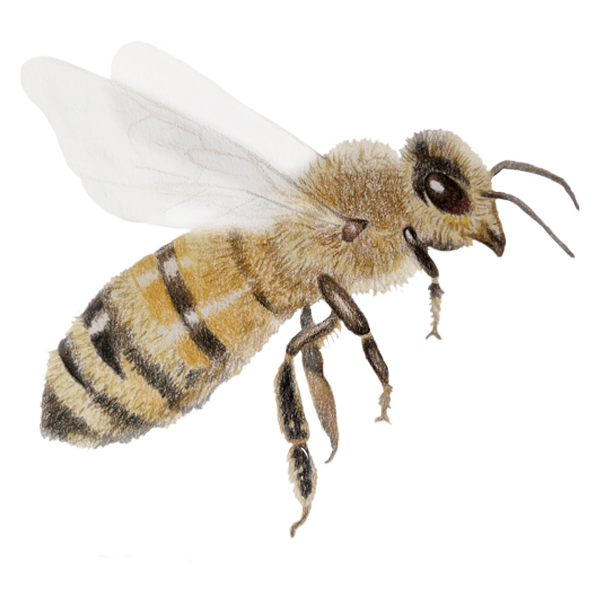
How can we assist the bees?
Thank you for visiting the Dreamweaver’s Grove!
I hope you’ll enjoy this summer adventure of the Auané and the honeybees.
Below, I’d like to share a few practical ways of how we can support the bees, especially at this time of year.
As summer draws to a close, honeybees shift from foraging and brood rearing to transition into winter preparation. Their numbers decline naturally as they conserve resources for the colder months.
Some wild bees, like leafcutter and mason bees, now prepare their nests for the next generation.
There are many ways in which we can assist them.
1. Those of us with a window sill, balcony or garden can sow native wildflowers. It’s best to focus on native plants that bloom at different times of the year, so the bees always have a source for nectar and pollen.
2. Leaving some garden space wild allows solitary bees to overwinter as larvae or adults in dead stems, leaf litter, and hollow plant stalks or underground, so undisturbed soil and plant debris are crucial for their survival.
3. Placing a shallow dish of water with pebbles or twigs for bees to land on helps them drink safely without drowning.
4. Supporting local, sustainable beekeepers by buying honey and beeswax products directly from them supports healthy honeybee populations and our local ecosystems.
These are just a few ways in which we can give back to all magnificent bees. Please feel free to share in the comments below if you have any more tips and advice.
Thank you, bees. We see you.
Peace to all beings.
You fellow Dreamweaver,
Stella
